



Iran Conflict Derails Recent Market Progress, Equities and Bonds Fall in March
HIGHLIGHTS:
- Stocks: In March, the S&P 500 Index posted its worst month since 2022.
- Bonds: Rates moved sharply higher during March, creating a difficult environment for bonds.
- U.S. Economy: Data released in March was mixed, but most of it was pre-conflict and therefore was not a central focus of the market.
- Federal Reserve: The FOMC did not make any changes at its March meeting. The market has completely priced out any cuts by the Fed in 2026 (based on the CME FedWatch tool as of March 31, 2026).
Equity Markets
Broad equity weakness was the theme in March after recent years of solid and steady stock market gains. A rally on the last day of March helped offset some of the declines, but the month was a challenge for equity investors. See Table 1 for March, Q1, and 2025 returns.
Table 1 | Equity Markets
| Index | March 2026 | Q1 | 2025 |
|---|---|---|---|
| S&P 500 | -4.98% | -4.33% | 17.88% |
| S&P 500 Equal Weight | -5.97% | 0.67% | 11.43% |
| DJIA | -5.20% | -3.19% | 14.92% |
| Russell 3000 | -4.97% | -3.96% | 17.15% |
| NASDAQ Comp. | -4.68% | -6.96% | 21.14% |
| Russell 2000 | -5.00% | 0.89% | 12.81% |
| MSCI ACWI ex U.S. | -10.79% | -0.71% | 32.39% |
| MSCI Emerging Mkts Net | -13.06% | -0.17% | 33.57% |
The conflict with Iran drove stock market results in March. Oil prices spiked as the Strait of Hormuz was for the most part closed, choking off about 20% of the global oil market supply. International markets were impacted more directly by the challenge of getting oil from this region as the U.S. receives minimal amounts of oil from the Middle East. In fact, the U.S. is a net oil exporter, vastly different than during the 1970s Oil Embargo. Despite this, U.S. gasoline prices were more directly and immediately impacted by oil prices moving higher. The average retail price increased by about $1 per gallon.
Clearly, March ushered in a period of high stock market volatility as concern developed regarding how the conflict would impact inflation, rate cut expectations, and broader economic progress. Most notable in Table 1 was the broad nature of this sell-off within U.S. equities, along with the pronounced impact on international markets, which are in general much more dependent on oil out of the Strait of Hormuz. Large-cap growth companies, which had struggled to begin 2026, continued to slide and showed the weakest year-to-date results based on the Nasdaq Composite. Small caps and the equal-weighted S&P 500 held on to modestly positive gains for the year reflecting broadening that has occurred in the market in recent months.
The market is very sensitive to developments on the Iran conflict, and any sign that this conflict might end soon is met by a strong recovery in the market, as we saw on the last day of the month. As this conflict preoccupies the market, keep in mind we also have midterm elections and a likely change in Fed leadership in the months ahead.
Fixed Income
Bonds struggled in March as interest rates moved higher and credit spreads widened. The 10-year U.S. Treasury closed below 4% for the first time in 2026 on the last day of February, only to hit its high for the year on March 27 at 4.44%. See Table 2 for bond index returns for March, Q1, and 2025.
Table 2 | Fixed Income Markets
| Index | March 2026 | Q1 | 2025 |
|---|---|---|---|
| Bloomberg U.S. Agg | -1.76% | -0.05% | 7.30% |
| Bloomberg U.S. Credit | -1.96% | -0.48% | 7.83% |
| Bloomberg U.S. High Yld | -1.18% | -0.50% | 8.62% |
| Bloomberg Muni | -2.32% | -0.18% | 4.25% |
| Bloomberg 30-year U.S. TSY | -3.92% | -0.14% | 3.73% |
| Bloomberg U.S. TSY | -1.74% | -0.04% | 6.32% |
The market had been pricing in two rate cuts by the Fed, but that all changed in March. With oil prices spiking higher and remaining elevated for most of the month, inflation concerns developed, and the market priced out any rate cuts in 2026. Odds at times favored a rate hike being more likely than a rate cut, but the highest probability was for no action either way. The basic tenet of bonds is as rates move higher, bond prices move lower, and that occurred in March, which wiped out the gains from earlier in the year. Like equities, the sell off was broad, and areas like munis, which had shown leadership earlier in the year, were hit hard during the month, pushing this index into negative territory year to date. We believe the 10-year U.S. Treasury will be range bound this year between 3.5% and 4.5%, and we have been in the upper end of that range in recent weeks.
We maintain our long-standing position favoring credit versus pure rate exposure in this interest rate environment. Credit has seen some volatility and spreads have widened, but the story has been much more about the general move higher in interest rates. We believe the role bonds play in a portfolio, to provide stable cash flow and to help offset the volatility of stocks in the long run, has not changed. With uncertainty ahead, we believe having an active bond management approach makes sense. Furthermore, rates remain elevated and provide attractive opportunities for bond investors.
Economic Data Highlights and Outlook
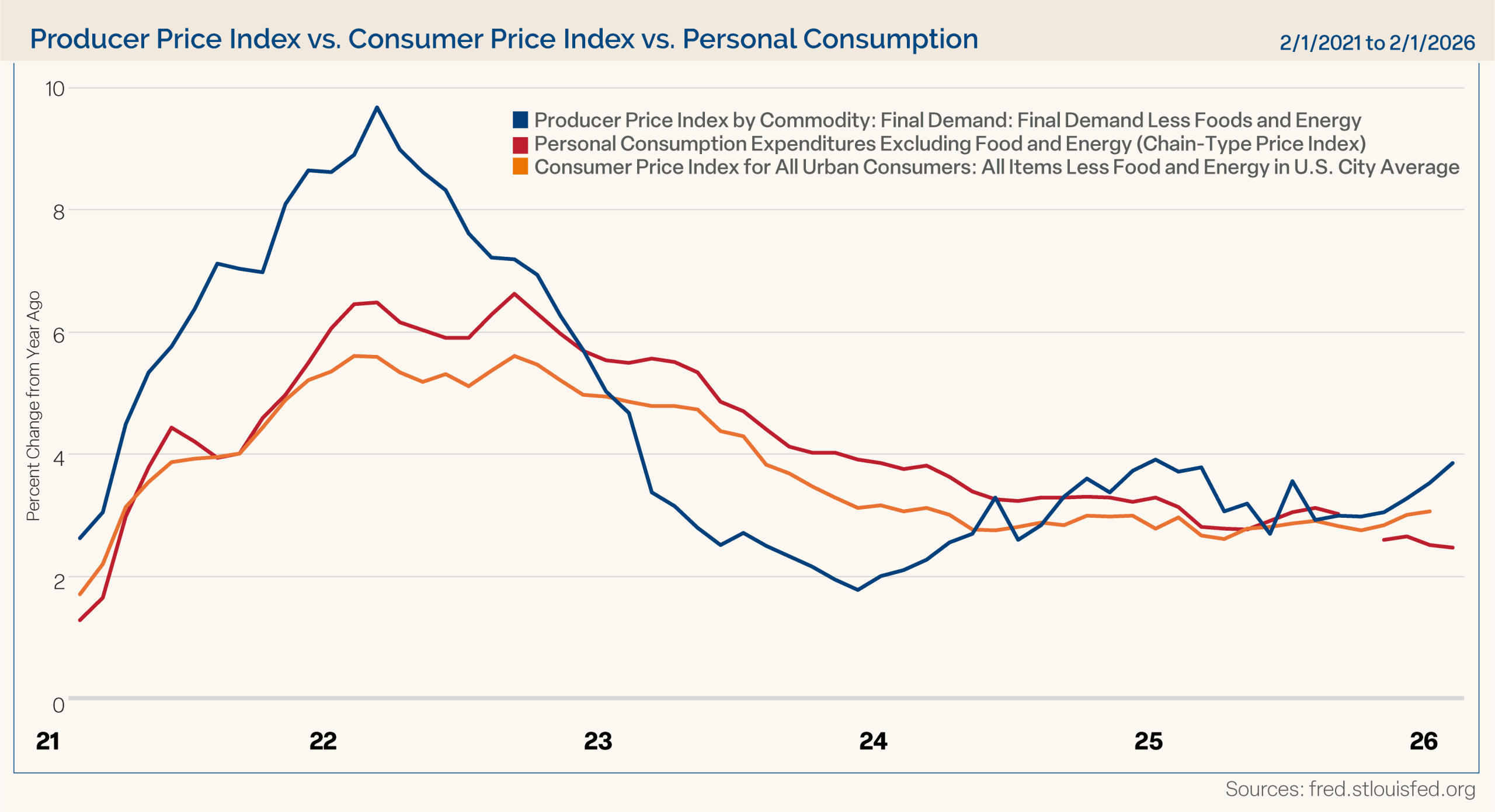
March data continued to show a mixed economic backdrop. Inflation data reflected this mixed picture. The Producer Price Index (PPI) for February surprised to the upside for a third straight month showing a developing trend that wholesale prices have risen of late. (And recall this is data from before the rise in oil prices in March.) Both headline and core PPIs were expected to come in with 0.3% monthly increases. Instead, they recorded increases of 0.7% and 0.5%, respectively. This move put the annual gains in wholesale prices at 3.4% (headline) and 3.9% (core), which were both well above expectations and increases from January.
The Consumer Price Index (CPI) remained rather subdued in February. The headline CPI reading was expected to increase 0.3% on a monthly basis, and the core CPI was expected to rise 0.2%. Both readings matched estimates. Once again matching expectations, the annual increases were 2.4% and 2.5%, respectively.
The Personal Consumption Expenditures (PCE) price index increased by 0.3% in January as expected, but the annual reading of 2.8% was better (lower) than expectations and the prior month’s annual gain of 2.9%. The core PCE price index (the preferred inflation measure used by the Fed) rose 0.4% in January and 3.1% on an annual basis, both matching expectations. For the third straight month, wholesale prices rose more than expected, but those price increases have not yet shown up dramatically in consumer inflation readings. This trend will be important to monitor moving forward, especially with the spike in oil prices that occurred in March. See Chart 1 for core inflation data.
Chart 1
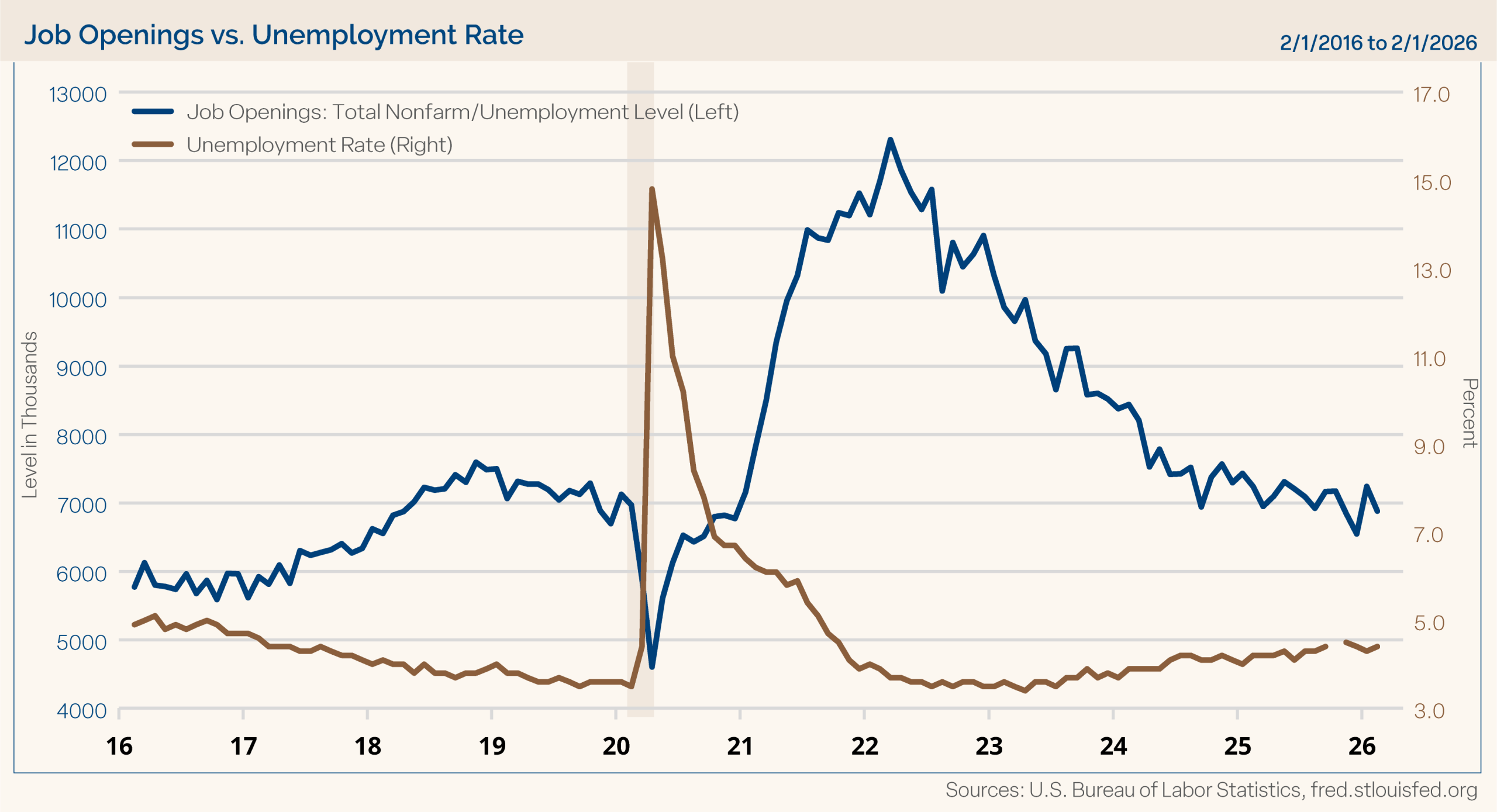
Payroll data was disappointing for February. Instead of the expected 55,000 job additions, payrolls fell by 92,000. Since June 2025, payrolls have declined in five of the last nine monthly readings showing a clear slowdown in hiring activity. The unemployment rate rose to 4.4% when it was expected to remain at its prior level of 4.3%. Job openings have declined over the last few years, and they dropped dramatically in December. The JOLTS reading of job openings improved in January from the weakest reading in over five years in December. For February, expectations called for 6890k job openings, and the reading was only slightly off this mark at 6882k and just below the January mark of 6946k. See Chart 2 below showing the slowly rising unemployment rate over the last few years and the declining number of job openings.
Chart 2
The Institute for Supply Management (ISM) Manufacturing Index provided more positive economic news to begin the new year. For the first time since February 2025, this ISM reading reflected expansion at 52.6 in January 2026. Backing up that reading, the ISM Manufacturing Index came in at 52.4 in February, exceeding expectations of 51.5. As we often say, one month is not a trend, but back-to-back months have reflected expansion in manufacturing to begin the year. More good news – this reading came in at 52.7 for March, ahead of expectations of 52.3, but prices paid moved higher and could be pointing to increasing inflation pressures. The ISM Non-Manufacturing Index, which covers the much larger service industries in the U.S. economy, continued to reflect expansion. This reading came in at 56.1 for February, showing solid growth, compared to expectations of 53.5. Recall for the ISM indices, readings above 50 represent expansion and below 50 reflect contraction. Both manufacturing and service industries have shown growth to begin 2026.
Consumer spending was solid in February with retail sales (ex-autos and gas) increasing 0.4% for the month, better than the 0.3% expectation. While rearview looking, the personal consumption portion of the second reading of Q4 GDP came in at a 2.0% annualized rate, less than the initial estimate of 2.4%. Consumer sentiment readings have been rather weak for some time, but we have not seen that translate into a meaningful drop in consumer spending. The preliminary University of Michigan Consumer Sentiment reading for March was better than expected at 55.5, but that was lower than the prior month. However, this reading declined in its final release for March, which occurred after the Iran conflict, to 53.3. Consumer spending will be important to monitor due to the central role that household consumption plays in the U.S. economy. U.S. consumers are resilient, but we will need to monitor if higher gas prices lead to less spending in other areas.
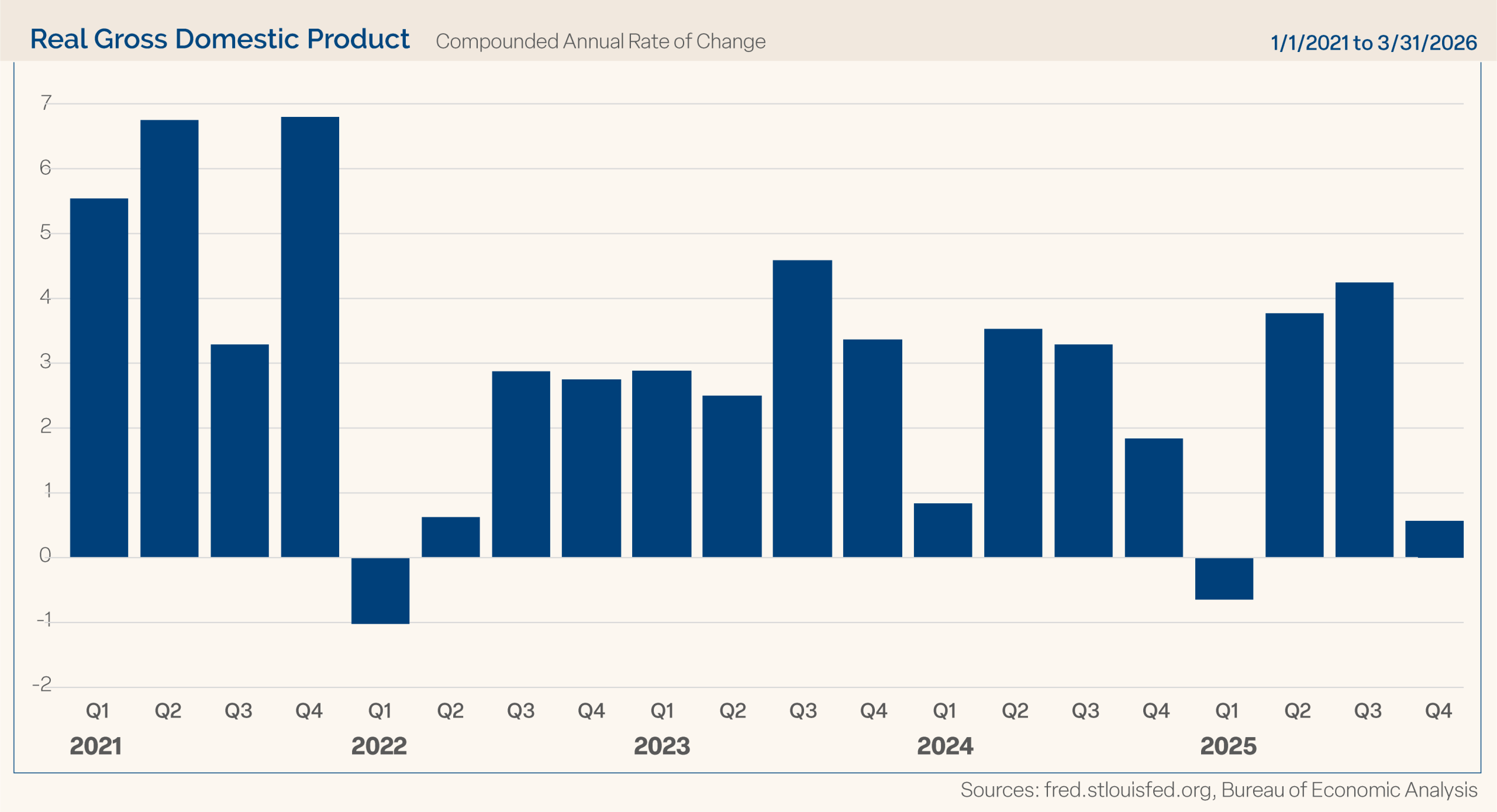
The second reading of Q4 GDP was revised sharply lower when released in March. Economic growth slowed to a 0.7% annualized pace, half of the preliminary GDP reading and expectations of 1.4%. Recall that part of this weakness was caused by the longest government shutdown in U.S. history (which the partial DHS shutdown has just surpassed). Personal spending also declined from the preliminary reading. It appears this could be a rather “noisy” GDP report due to the impact of the government shutdown and harsh weather across much of the country, but the second revision to the reading reflected a rather weak end to the year for the U.S. economy. The GDPNow forecast from the Atlanta Fed for Q1 2026 GDP shows the economy starting out 2026 on solid footing with a current estimate of 2.0% annualized growth (as of March 31, 2026). Chart 3 below shows GDP in recent years and the two strong quarters in the middle of 2025 bookended by weaker quarters.
Chart 3
The FOMC met in March and made no change to policy rates as expected. No progress has been made in the nomination process for the new Fed Chair, Kevin Warsh. The process is being held up until the investigation into Fed Chair Powell has concluded. Per the CME FedWatch tool on April 1, 2026, the market has lowered expectations of rate cuts with the probability at just over 72% of no cut or hike in 2026.
Clearly, there is still a lot of uncertainty with the Iran conflict and the impact it will have on the broader global economy and capital markets. The stock and bond market became almost singularly focused on the conflict in Iran in March. While not dismissing the human toll of this conflict, many positive market factors still exist as we move into the second quarter. Earnings are expected to grow in the mid-teens in 2026. Small- and mid-cap companies have seen earnings growth momentum pick up as well. Large-cap growth companies have become meaningfully cheaper as stock prices have come down, but earnings expectations have not. Manufacturing has shown recent expansion, and the service industries have shown ongoing solid growth.
Although the Fed is more in a wait-and-see mode, rate hikes are still unlikely in the near term, in our opinion. Inflation might move higher with oil price increases, but we believe this will be more of a shorter-term event. Undoubtedly, rising gas prices hurt many Americans, and we will monitor the impact this has on spending going forward. The job market continues to be rather weak, but this has been an ongoing theme over the last several quarters as businesses seem to be in a “no hire, no fire” environment. We still see opportunities in the stock and bond markets as we move into the second quarter of 2026. Volatility is a normal part of being an equity investor, and it came back in force in March. Even with recent weakness, the S&P 500 is still down less than 5% through the first quarter of the year. As always, we believe it is imperative for investors to stay focused on their long-term goals and not let short-term swings in the market, which could materialize at any time, derail them from their longer-term objectives.
Please Note: Most economic data has caught up from the government shutdown, however a few readings are still delayed and behind their typical schedule.
Economic Data
| Event | Period | Estimate | Actual | Prior | Revised |
|---|---|---|---|---|---|
| ISM Manufacturing | Feb | 51.5 | 52.4 | 52.6 | — |
| ISM Services Index | Feb | 53.5 | 56.1 | 53.8 | — |
| Change in Nonfarm Payrolls | Feb | 55k | -92k | 130k | 126k |
| Unemployment Rate | Feb | 4.30% | 4.40% | 4.30% | — |
| Average Hourly Earnings YoY | Feb | 3.70% | 3.80% | 3.70% | — |
| JOLTS Job Openings | Feb | 6890k | 6882k | 6946k | — |
| PPI Final Demand MoM | Feb | 0.30% | 0.70% | 0.50% | — |
| PPI Final Demand YoY | Feb | 3.00% | 3.40% | 2.90% | — |
| PPI Ex Food and Energy MoM | Feb | 0.30% | 0.50% | 0.80% | — |
| PPI Ex Food and Energy YoY | Feb | 3.70% | 3.90% | 3.60% | 3.50% |
| CPI MoM | Feb | 0.30% | 0.30% | 0.20% | — |
| CPI YoY | Feb | 2.40% | 2.40% | 2.40% | — |
| CPI Ex Food and Energy MoM | Feb | 0.20% | 0.20% | 0.30% | — |
| CPI Ex Food and Energy YoY | Feb | 2.50% | 2.50% | 2.50% | — |
| Retail Sales Ex Auto and Gas | Feb | 0.30% | 0.40% | 0.30% | 0.20% |
| Industrial Production MoM | Feb | 0.10% | 0.20% | 0.70% | — |
| Building Permits | Jan P | 1410k | 1376k | 1455k | __ |
| Housing Starts | Jan | 1341k | 1487k | 1404k | 1387k |
| New Home Sales | Jan | 722k | 587k | 745k | 712k |
| Existing Home Sales | Feb | 3.88m | 4.09m | 3.91m | 4.02m |
| Leading Index | Jan | -0.10% | -0.10% | -0.20% | — |
| Durable Goods Orders | Jan P | 1.10% | 0.00% | -1.40% | -0.90% |
| GDP Annualized QoQ | 4Q S | 1.40% | 0.70% | 1.40% | — |
| U. of Mich. Sentiment | Mar P | 54.8 | 55.5 | 56.6 | — |
| Personal Income | Jan | 0.50% | 0.40% | 0.30% | — |
| Personal Spending | Jan | 0.30% | 0.40% | 0.40% | — |
| S&P Cotality CS 20-City YoY NSA | Jan | 1.38% | 1.18% | 1.38% | 1.43% |
Source: Bloomberg; P=Preliminary, T=Third Reading
For illustrative purposes only. Past performance is not indicative of future results. Neither past actual, projections, nor other forward looking statements regarding future financial performance of markets are only projections and actual events or results may differ materially.
Disclosures
Forward looking statements cannot be guaranteed. Past performance is not indicative of future results. The opinions referenced are as of the date of publication and are subject to change due to changes in the market or economic conditions and may not necessarily come to pass. Material presented has been derived from sources considered to be reliable and has not been independently verified by us or our personnel. Nothing herein should be construed as a solicitation, recommendation or an offer to buy, sell or hold any securities, other investments or to adopt any investment strategy or strategies. Investors must make their own decisions based on their specific investment objectives and financial circumstances. Investing involves risk, including loss of principal.
Clark Capital Management Group is an investment adviser registered with the U.S. Securities and Exchange Commission. Registration does not imply a certain level of skill or training. More information about Clark Capital Management Group’s advisory services can be found in its Form ADV and/or Form CRS, which are available upon request.
The manager utilizes a proprietary investment model to assist with the construction of the strategy and to assist the manager with making investment decisions. Investments selected using this process may perform differently than expected as a result of the factors used in the model, the weight placed on each factor, and changes from the factors’ historical trends. There is no guarantee that Clark Capital’s use of a model will result in effective investment decisions.
Fixed income securities are subject to certain risks including, but not limited to: interest rate (changes in interest rates may cause a decline in market value or an investment), credit, prepayment, call (some bonds allow the issuer to call a bond for redemption before it matures), and extension (principal repayments may not occur as quickly as anticipated, causing the expected maturity of a security to increase).
Non-investment-grade debt securities (high-yield/junk bonds) may be subject to greater market fluctuations, risk of default or loss of income and principal than higher-rated securities.
The value of investments, and the income from them, can go down as well as up and you may get back less than the amount invested.
Equity securities are subject to price fluctuation and possible loss of principal. Stock markets tend to move in cycles, with periods of rising prices and periods of falling prices. Certain investment strategies tend to increase the total risk of an investment (relative to the broader market). Strategies that concentrate their investments in limited sectors are more vulnerable to adverse market, economic, regulatory, political, or other developments affecting those sectors.
JOLTS is a monthly report by the Bureau of Labor Statistics (BLS) of the U.S. Department of Labor counting job vacancies and separations, including the number of workers voluntarily quitting employment.
The Core Consumer Price Index (CPI) is a measure of the average change over time in the prices paid by urban consumers for a market basket of consumer goods and services.
The Core Producer Price Index (PPI) program measures the average change over time in the selling prices received by domestic producers for their output. The prices included in the PPI are from the first commercial transaction for many products and some services.
The PCE price index, released each month in the Personal Income and Outlays report, reflects changes in the prices of goods and services purchased by consumers in the United States.
References to market or composite indices, benchmarks or other measures of relative market performance over a specified period of time (each, an “index”) are provided for your information only. Reference to an index does not imply that the portfolio will achieve returns, volatility or other results similar to that index. The composition of the index may not reflect the manner in which a portfolio is constructed in relation to expected or achieved returns, portfolio guidelines, restrictions, sectors, correlations, concentrations, volatility or tracking error targets, all of which are subject to change. Investors cannot invest directly in an index.
The Dow Jones Industrial Average® (The Dow®), is a price-weighted measure of 30 U.S. blue-chip companies.
The index covers all industries except transportation and utilities.
The Bloomberg Barclays U.S. Municipal Index covers the USD-denominated long-term tax exempt bond market. The index has four main sectors: state and local general obligation bonds, revenue bonds, insured bonds and prerefunded bonds.
The Bloomberg US Treasury Index measures US dollar-denominated, fixed-rate, nominal debt issued by the US Treasury. Treasury bills are excluded by the maturity constraint, but are part of a separate Short Treasury Index.
The NASDAQ Composite is a stock market index of the common stocks and similar securities listed on the NASDAQ
stock market.
The S&P 500 measures the performance of the 500 leading companies in leading industries of the U.S. economy, capturing 80% of U.S. equities.
The S&P 500® Equal Weight Index (EWI) is the equal-weight version of the widely-used S&P 500. The index includes the same constituents as the capitalization weighted S&P 500, but each company in the S&P 500 EWI is allocated a fixed weight or 0.2% of the index total at each quarterly rebalance.
The University of Michigan Consumer Sentiment Index rates the relative level of current and future economic conditions. There are two versions of this data released two weeks apart, preliminary and revised. The preliminary data tends to have
a greater impact. The reading is compiled from a survey of around 500 consumers.
The Russell 1000 Index is a stock market index that tracks the highest-ranking 1,000 stocks in the Russell 3000 Index, which represent about 93% of the total market capitalization of that index.
The Russell 2000 Index is a small-cap stock market index that represents the bottom 2,000 stocks in the Russell 3000.
The Russell 3000 Index measures the performance of the 3,000 largest U.S. companies based on total market capitalization, which represents approximately 98% of the investable U.S. equity market.
Russell 1000 Growth Index tracks companies with higher price-to-book ratios, higher sales per share growth, and higher I/B/E/S forecast growth.
Russell 1000 Value Index tracks companies with lower price-to-book ratios and lower expected and historical growth rates. Russell’s value indexes focus more on dividend yield.
Nonfarm payrolls (NFPs) are the measure of the number of workers in the United States excluding farm workers and workers in a handful of other job classifications.
A municipal bond, commonly known as a muni, is a bond issued by state or local governments, or entities they create such as authorities and special districts.
The CBOE Volatility Index (VIX) is a real-time index that measures the expected volatility of the S&P 500 over the next
30 days.
The U.S. Treasury index is based on the recent auctions of U.S. Treasury bills. Occasionally it is based on the U.S. Treasury’s daily yield curve.
The 30 Year Treasury Rate is the yield received for investing in a US government issued treasury security that has a maturity of 30 years.
The Bloomberg Barclays U.S. Corporate High-Yield Index covers the U.S. dollar-denominated, non-investment grade, fixed-rate, taxable corporate bond market. Securities are classified as high-yield if the middle rating of Moody’s, Fitch,
and S&P is Ba1/BB+/BB+ or below.
The Bloomberg Barclays U.S. Credit Index measures the investment grade, U.S. dollar denominated, fixed-rate taxable corporate and government related bond markets.
The Bloomberg Aggregate Bond Index or “the Agg” is a broad-based fixed-income index used by bond traders and the managers of mutual funds and exchange-traded funds (ETFs) as a benchmark to measure their relative performance.
The Bloomberg US Trsy Bellwether 30Y is a U.S. Treasury debt obligation that has a maturity of 30 years.
The ISM Non-Manufacturing Index is an index based on surveys of more than 400 non-manufacturing firms’ purchasing and supply executives, within 60 sectors across the nation, by the Institute of Supply Management (ISM). The ISM Non-Manufacturing Index tracks economic data, like the ISM Non-Manufacturing Business Activity Index. A composite diffusion index is created based on the data from these surveys, that monitors economic conditions of the nation.
ISM Manufacturing Index measures manufacturing activity based on a monthly survey, conducted by Institute for Supply Management (ISM), of purchasing managers at more than 300 manufacturing firms.
The MSCI Emerging Markets Index captures large and mid cap representation across 27 Emerging Markets (EM) countries.
The MSCI ACWI ex USA Index captures large and mid cap representation across 22 of 23 Developed Markets (DM) countries (excluding the US) and 27 Emerging Markets (EM) countries*. With 2,359 constituents, the index covers approximately 85% of the global equity opportunity set outside the US.
The S&P CoreLogic Case-Shiller 20-City Composite Home Price NSA Index seeks to measures the value of residential real estate in 20 major U.S. metropolitan areas. The U.S. Treasury index is based on the recent auctions of U.S. Treasury bills. Occasionally it is based on the U.S. Treasury’s daily yield curve.
The Leading Economic Index provides an early indication of significant turning points in the business cycle and where the economy is heading in the near term.
In the United States, the Core Personal Consumption Expenditure Price (CPE) Index provides a measure of the prices paid by people for domestic purchases of goods and services, excluding the prices of food and energy.
The Conference Board’s Leading Indexes are the key elements in an analytic system designed to signal peaks and troughs in the business cycle. The leading, coincident, and lagging economic indexes are essentially composite averages of several individual leading, coincident, or lagging indicators. They are constructed to summarize and reveal common turning point patterns in economic data in a clearer and more convincing manner than any individual component – primarily because they smooth out some of the volatility of individual components.
Gross domestic product (GDP) is the standard measure of the value added created through the production of goods and services in a country during a certain period.